

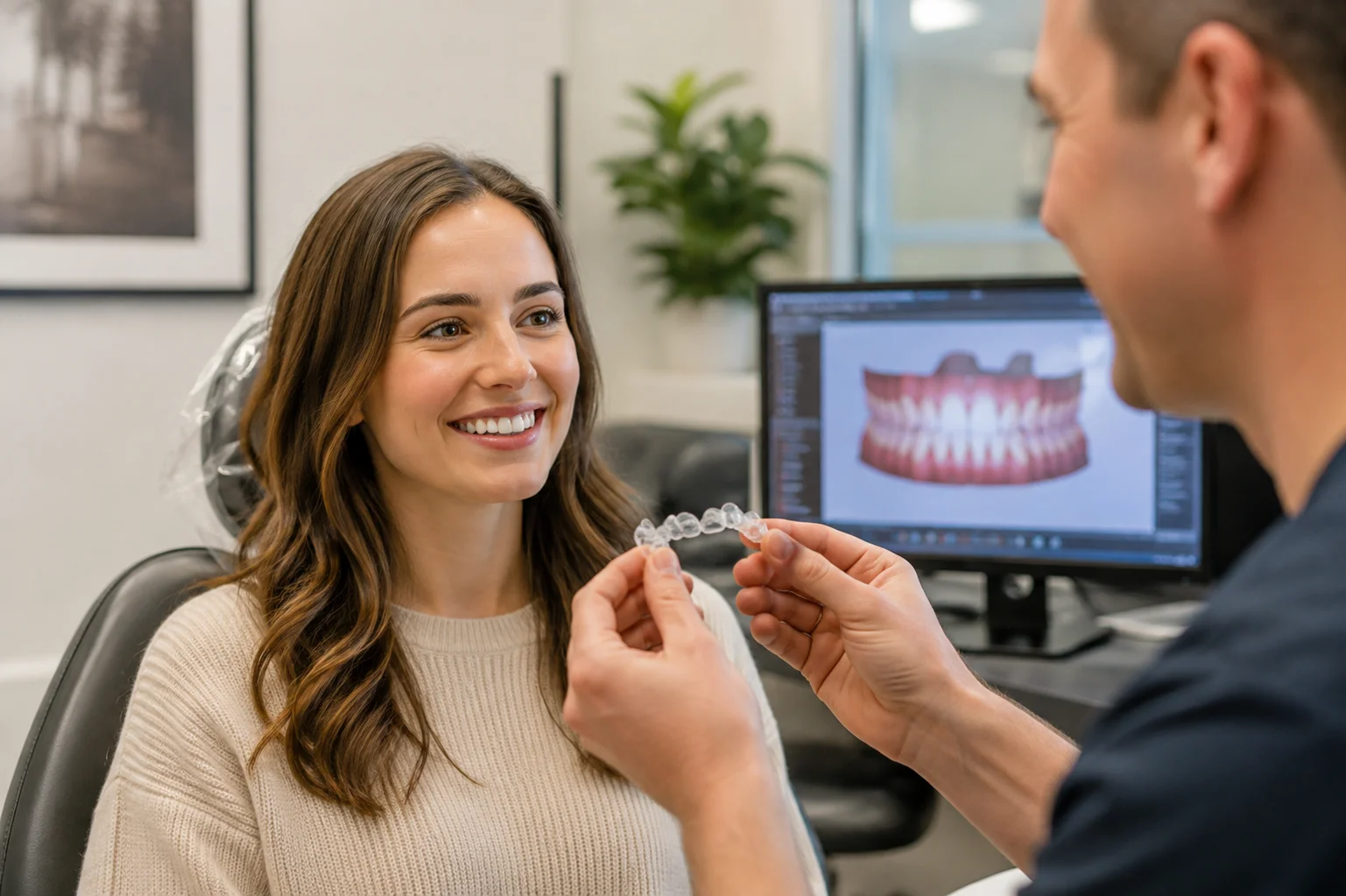
You have wanted straighter teeth for years, and you finally called about clear aligners. Then someone asked whether your insurance covers it, and you had no answer. Dr. Andrew Randall, who completed advanced education in general dentistry at the VCU School of Dentistry, hears this question from University Park families every week. He is a member of the American Dental Association. At Evans and Randall Dentistry, the answer starts before anyone talks about money.
Here is the short version. Your coverage depends on whether your plan includes an orthodontic benefit, not on which aligner brand your dentist uses. Insurance companies pay against treatment codes, and no carrier maintains a separate code for one manufacturer. Understanding clear aligner treatment and how your benefits apply puts you in a far stronger position. The same principle holds across most cosmetic dentistry services carrying a functional component.
Does dental insurance cover Invisalign?
Plans with orthodontic benefits generally cover a percentage of comprehensive orthodontic treatment, up to a lifetime maximum written into your policy. Your carrier processes the claim against a procedure code for orthodontic treatment. There is no Invisalign code. There is no ClearCorrect code. A plan covering comprehensive orthodontic treatment covers the treatment, whichever aligner system your dentist selects.
This surprises most patients, and it changes how you should read your benefits booklet. Stop looking for a brand name in your policy documents, because you will not find one. Look instead for the words orthodontia or orthodontic services, and check whether your plan includes them at all. Many dental plans exclude orthodontics entirely, and no aligner brand overcomes a plan with no orthodontic benefit attached.
Which insurance plans cover clear aligners?
Orthodontic coverage arrives as a rider or as an included benefit, and plan design varies widely between employers. Two people at the same company can hold different levels of coverage. These patterns show up most often across orthodontic treatment plans in the Park Cities.
- PPO plans with an orthodontic rider, which usually cover a share of treatment for children and adults
- PPO plans without a rider, which cover general dentistry but exclude orthodontics completely
- Plans with a dependent age limit, often ending coverage at nineteen for a policyholder’s children
- Plans with a waiting period, requiring continuous enrollment before orthodontic benefits activate
- Discount plans, which reduce fees through a network rather than paying a share of treatment
Your booklet holds the answer, though the language rarely makes it obvious. Call the member services number on your card and ask directly about orthodontic benefits for your age group. Write down what you hear, including the name of the person who told you.
How much does insurance pay toward clear aligner treatment?
Coverage arrives as a percentage of treatment, capped by a lifetime orthodontic maximum. That lifetime maximum works differently from your annual maximum, and confusing the two costs patients real money. An annual maximum resets every January. A lifetime orthodontic maximum does not reset at all, and once you use it the benefit is gone for good.
| Your plan situation | Typical orthodontic position | What to confirm before treatment |
| PPO with orthodontic rider | Shares treatment cost up to a lifetime cap | Whether adults qualify or only dependents |
| PPO without rider | No orthodontic benefit applies | Whether a rider can be added at open enrollment |
| Coverage used as a teenager | Lifetime maximum may be partly or fully spent | How much of the lifetime benefit remains |
| Recently enrolled plan | Waiting period may still apply | The exact date orthodontic benefits begin |
Read the third row carefully, because it catches adults constantly. Many patients wore braces as teenagers on a parent’s plan and never learned whether the benefit followed them. A lifetime maximum belongs to the plan rather than to you, so a new employer plan usually brings a fresh benefit. Your current carrier confirms your remaining balance in one phone call.
Why does insurance cover some aligner cases and not others?
Carriers evaluate orthodontic claims on the clinical picture, not on the appearance of the finished smile. Documented crowding, bite interference, wear patterns and jaw symptoms sit differently in a claim than an aesthetic request does. Two patients wearing identical aligners can receive different coverage decisions for exactly this reason.
This is where a thorough examination earns its place. Dr. Randall and Dr. Evans evaluate how your teeth meet, how your joints tolerate the bite, and what caused the crowding originally. Those findings belong in your record whether or not they change a coverage outcome. Patients exploring invisible braces benefit from the same evaluation regardless of which appliance follows.

How do you find out what your plan covers?
You can answer most of this before your first appointment, and doing so removes the largest unknown from the decision. Patients across University Park and the Park Cities tell us the uncertainty bothers them more than the number itself. Work through these steps in order.
- Call member services and ask whether your plan includes adult orthodontic benefits
- Ask for your lifetime orthodontic maximum and how much of it remains unused
- Confirm whether a waiting period applies and when orthodontic benefits become active
- Request a predetermination of benefits once a treatment plan exists
- Check whether your employer offers a flexible spending or health savings account
A predetermination costs you nothing beyond a little patience. Your carrier reviews the proposed treatment and states what it expects to pay before anything begins. Our team helps general dentistry patients gather the records needed for that request.
What happens if your teeth move back after treatment?
Teeth drift throughout life, and orthodontic results require active maintenance to hold. Retainers exist because the bone and soft tissue around your teeth need time to reorganize after movement. Skipping retainer wear invites relapse, and a lifetime orthodontic maximum rarely refills for a second round of treatment.
There is a deeper version of this question, and it matters more than the retainer schedule. If your teeth crowded because of how your bite functions or because you clench at night, aligning them without addressing the cause invites the same result again. Dr. Randall examines the bite behind the teeth before recommending any tooth movement, drawing on the same approach used in TMJ therapy. Individual results vary, and a thorough evaluation is where lasting outcomes start.
Call Evans and Randall Dentistry Today. Find Out What Your Plan Covers.
You have carried this question long enough, and you deserve a clear answer before committing to anything. Park Cities families come to Evans and Randall Dentistry because they want someone who explains the why before the what. Dr. Andrew Randall and Dr. Scott Evans examine how your bite functions, walk you through your options, and help you understand where your benefits apply.
You are the one making this decision, and our job is giving you what you need to make it well. Call Evans and Randall Dentistry at 214-750-4901 to schedule an evaluation at our Sherry Lane office. We will look at your teeth, your bite, and your coverage together, and you will leave knowing exactly where you stand.
Frequently Asked Questions
Does insurance cover clear aligners for adults?
Adult coverage depends entirely on plan design, and many plans limit orthodontic benefits to dependent children. Where a plan does include adult orthodontics, dental plans generally treat braces and clear aligners the same way, with coverage varying between providers. Adult treatment has become far more common than most patients expect, and roughly one in three orthodontic patients today is an adult. Ask your carrier about adult eligibility specifically rather than orthodontic coverage in general.
What is a lifetime orthodontic maximum?
A lifetime orthodontic maximum is the total your plan will ever pay toward orthodontic treatment for one person. It differs from an annual maximum, and plan documents describing orthodontic benefits show why reading them closely matters before treatment starts. Orthodontic care aims at a functional result, and the health reasons behind treatment explain why carriers evaluate cases clinically. Once the lifetime maximum is spent, no further orthodontic benefit remains on the plan.
Can I use an FSA or HSA for clear aligner treatment?
Orthodontic treatment generally qualifies as a medical or dental expense for flexible spending and health savings accounts. The federal definition covers care aimed at diagnosis, treatment or prevention, and the published guidance on medical and dental expenses sets the standard your administrator applies. Keep your treatment contract and receipts, because administrators frequently request documentation. Choosing a licensed dentist matters here, and state resources on verifying a provider explain how.
Will my plan cover treatment if I had braces as a teenager?
Often yes, particularly where you now hold coverage through a different employer than your parents did. The lifetime maximum attaches to the plan, so a new plan usually brings an unused benefit. Relapse after earlier treatment is common, because teeth continue shifting throughout life and retention counters that tendency. Retention is a permanent part of orthodontic care, and guidance on retainer types and long-term wear explains what maintenance involves. Individual results vary.