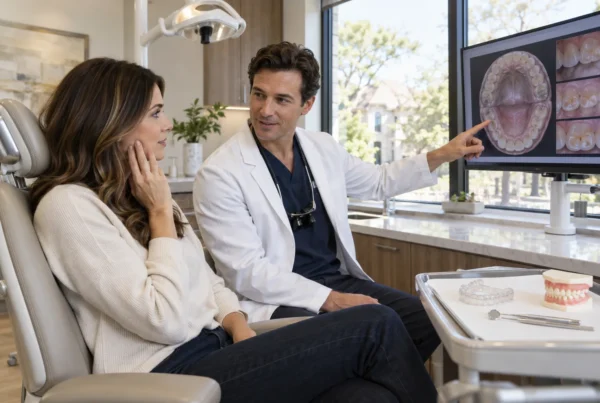


What You Are Paying For When a Dentist Adjusts Your Bite
Bite adjustment cost is hard to pin down because two different procedures share one name. One smooths a new filling or crown so it meets the teeth you already had, which is routine chairside work. The other reshapes natural enamel to change how your bite closes. Park Cities patients fear paying for permanent work they did not need, and that fear is well placed. This page shows which one you are being quoted in University Park. Dr. Andrew Randall earned his dental degree from Texas A&M Baylor College of Dentistry and treats the bite behind the teeth. Our TMJ therapy page covers jaw treatment, while this one stays on cost.
The distinction matters because enamel does not grow back once it is reduced. A reshaping you did not need cannot be reversed, and the next dentist inherits whatever bite you were left with. Our article on teeth grinding and bruxism explains the habit that sends many people down this road. At Evans and Randall Dentistry the exam comes before the estimate.
What Are You Paying For in a Bite Adjustment?
Roughly 11 to 12 million adults in the United States have pain in the region of the temporomandibular joint. Many of them get offered some version of a bite adjustment at some point. The term covers two procedures with quite different purposes, and only one of them sets out to change a bite.
Source: Agency for Healthcare Research and Quality, Effective Health Care Program, temporomandibular dysfunction topic brief, nomination 1029, dated 7 February 2023. The same brief reports the condition is especially common in women between 35 and 44 years old.
The first version is ordinary chairside work that follows a new crown or filling. Your dentist marks the contact that sits high, polishes it down, and you leave with the bite you walked in with. Most practices treat that as part of the restoration, so ask whether it carries its own fee.
Why Does One Bite Adjustment Cost More Than Another?
The price gap comes from how many teeth get touched and how much planning sits in front of it. Easing one high contact is a brief visit with no records and no workup. Reshaping many teeth is a planned case built on a bite evaluation, mounted models, and several separate visits over weeks.
Those are not two sizes of one service, because the second changes your bite deliberately. It carries consequences the first one does not, and your estimate should make clear which of the two it describes. An office that cannot answer quickly is quoting a line item, not a plan.
If a treatment plan names a figure without naming the procedure, ask for it in writing before you agree. Patients in University Park often arrive holding a quote they cannot interpret. That single question tends to reshape the whole conversation, more than any amount of reading beforehand.
Which Factors Change the Price You Are Quoted?
Five things decide the figure on your estimate, and each one is reasonable to ask about. Most patients never learn which of them were decided for them. Each one changes how many teeth are involved, how much diagnosis comes first, or what gets billed separately.
- How many teeth get reshaped, since one contact and a full arch are different procedures
- Whether a bite evaluation and mounted models come first, which adds a diagnostic stage
- Whether the work follows new dental work you already paid for
- Whether a removable appliance gets tried before any enamel is touched
- Whether follow-up visits are inside the quoted figure or billed when you return
Ask which of those five your estimate assumes, since the answer reveals what kind of plan you have. A quote bundling diagnosis and reshaping hides the decision you still have. You want the diagnosis priced separately, so you can decide about reshaping once the findings are in.
Which Kind of Bite Adjustment Is on Your Treatment Plan?
Three procedures travel under this name, and the column that matters most is whether the change can be undone. Read that column before you read any figure on the estimate. Enamel removal is permanent in every row below except the first, which only restores what you had.
| What it is | What it is for | Can it be undone | What to confirm before you agree |
| Adjusting new dental work | Making a new filling or crown meet the bite you already had | Yes, it restores your original bite | Whether it is included in the restoration fee |
| Limited reshaping of a natural tooth | Easing one specific contact that interferes | No, enamel does not grow back | What the exam found that points to that tooth |
| Reshaping many natural teeth | Changing your overall bite as a therapy | No, and it cannot be reversed | Whether a removable appliance was tried first |
The third row is the one worth slowing down on, and most patients move past it quickly. It differs from the first row in kind rather than degree. A practice that explains that difference unprompted is telling you something useful about how it works.

What Should You Ask Before Anyone Reshapes a Tooth?
Five questions protect you here, and a practice that welcomes them is usually planning care. Each one is fair to ask before any enamel comes off. The answers tell you whether a real diagnosis sits behind the recommendation, or whether it does not.
- What did the exam find, and which specific teeth are involved
- Is this restoring new dental work or changing my natural bite
- Has a removable appliance been tried, and what happened
- What happens if I wait and we watch this instead
- How will we know afterward whether it worked
Write the answers down before you leave the office, because the detail fades fast on the drive home. A patient who can repeat the exam findings can judge the estimate. That is the position you want before anyone removes enamel from a tooth.
Is Reshaping Teeth the Right Fix for Jaw Pain?
Federal guidance says no, at least not as a first step, across two separate reviews. The National Institute of Dental and Craniofacial Research advises avoiding treatments that cause permanent changes in the teeth and bite. It names grinding down teeth among those treatments, and an AHRQ review agrees.
Source: National Institute of Dental and Craniofacial Research, TMD: Less Is Often Best, May 2022. Agency for Healthcare Research and Quality, temporomandibular dysfunction topic brief, 7 February 2023, which states that guidance is consistent in recommending reversible conservative approaches to treatment.
A custom night guard or a similar removable appliance belongs in the conversation before any reshaping does. A guard comes out in the morning, and enamel never comes back. Results vary by patient, and what any approach achieves depends on the exam findings. Families near Mockingbird Lane and Caruth Park get that evaluation before anyone proposes permanent work on a tooth.
Find Out What Your Bite Needs First.
Dr. Andrew Randall and Dr. Scott Evans evaluate the bite first, which is the difference between a plan and a line item. Dr. Randall holds Texas dental license #19682 and completed an advanced general dentistry residency at VCU. Dr. Evans sees Park Cities families alongside him under Texas license #15030. University Park and Highland Park patients leave the first visit knowing what the exam found.
You keep your enamel, you understand the estimate, and you decide about permanent work with the findings in hand. Individual results vary, and the right approach depends on what the evaluation shows. Call Evans and Randall Dentistry at 214-750-4901 or request a visit online to start with the exam rather than the quote.
Questions Park Cities Patients Ask About Bite Adjustment
Is occlusal adjustment necessary?
Often it is not, and the exam settles that question rather than a reflex. MedlinePlus notes that very few people have perfect teeth alignment, and that most problems are minor and do not require treatment. The useful question is what your own exam found, and whether it explains your symptom.
Can TMJ make your bite feel off?
It can, and the two connect closely enough that one exam should look at both. Cleveland Clinic lists a misaligned bite among the reasons temporomandibular disorders occur, and notes the condition is treatable and rarely causes lasting problems. A bite that suddenly feels different deserves an evaluation rather than immediate reshaping.
What should I do when my bite feels off?
Start by having it looked at, and resist the urge to treat it as an emergency. Mayo Clinic notes that the pain and discomfort related to TMJ disorders usually lasts for only a limited time. Constant pain or trouble opening your jaw warrants prompt attention, and results vary.
How can I tell if my bite is too high?
You often cannot tell reliably on your own, which is one reason the exam matters more than guessing. The American Dental Association notes that teeth which do not line up can contribute to grinding. It adds that dentists and hygienists often notice the signs first. Soreness on one tooth when you chew is worth reporting rather than waiting out.